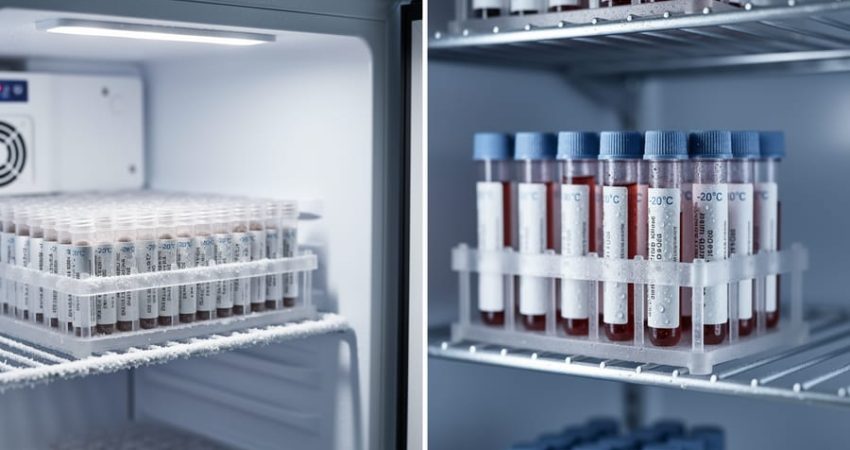
Use the freezer for lyophilized research peptides you won’t touch for three months or more, and keep the fridge for short-term storage and anything already reconstituted. The reason is simple: cold slows degradation, and a standard -20°C freezer keeps most lyophilized peptides stable for 12 to 24 months or longer. If you’re sorting out sourcing questions, kylopeptides.ca/ is one place to start. A regular fridge at 2-8°C does the job if you plan to use the vial within one to three months. Once a peptide is mixed with liquid, it always belongs in the fridge, not the freezer.
In the interest of transparency, we earn a commission on some purchases made through links on this site. As an Amazon Associate I earn from qualifying purchases.
This guide is for anyone setting up a storage routine, whether you’re a first-timer or you’ve been organizing a lab shelf for years. Runners know that small habits, like laying out your shoes the night before, protect the big goals. Storage works the same way. It’s also worth reading why research peptides aren’t a fit for your training. We tested the Midea 3.1 Cu.ft Mini Fridge with Freezer and the Carlisle FoodService Products StorPlus Round Food Storage Container as practical setups, and we’ll share honest observations on both below.
Freezer vs. Fridge at a Glance
If you want the answer in seconds, this table covers it. Think of it as the cheat sheet you’d tape inside a cabinet door.
| Dimension | Standard Refrigerator | Standard Freezer |
|---|---|---|
| Temperature | 2-8°C | -20°C |
| Ideal storage window | Use within 1-3 months | 3+ months |
| Typical stability (lyophilized) | Best for short-term use | Most remain stable for 12-24 months or longer |
| Reconstituted peptides | Always stored here at 2-8°C (36-46°F) | Not the home for mixed peptides |
| Best fit | Vials you’ll use soon | Vials you’re saving for later |
The pattern is simple. Lyophilized, or freeze-dried, powder you plan to use within a few months does well in the fridge. Powder you’re setting aside for the long haul belongs in the freezer, where the colder temperature buys you a much longer stability window.
Once a peptide is mixed, the rules change. Reconstituted peptides always go back in the refrigerator at 36-46°F (2-8°C), no matter how long they were frozen beforehand.
Don’t worry about memorizing every number. Just remember the rhythm: fridge for the short haul, freezer for the long haul, and fridge again after mixing. The sections ahead explain the reasoning so the rule sticks.
What Each Cold Storage Option Is
The Refrigerator: Everyday Short-Term Storage
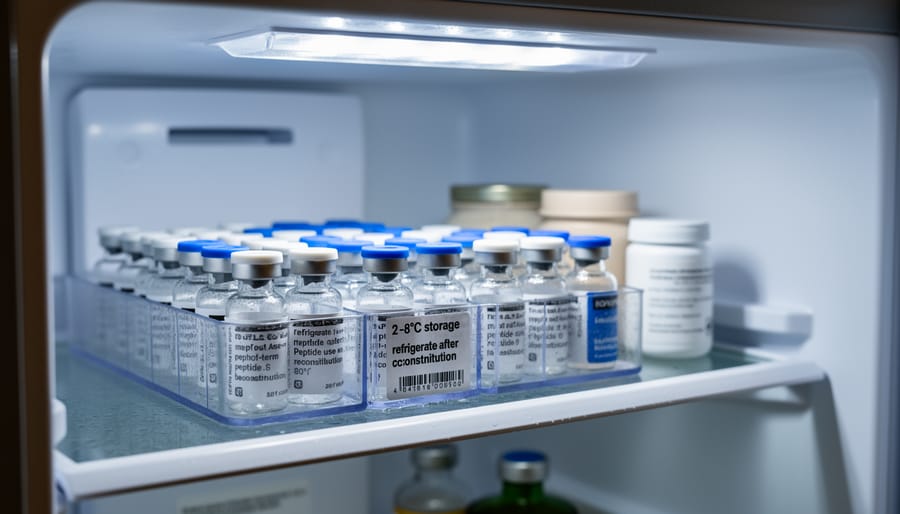
Think of the fridge as your everyday workhorse. It holds a steady 2-8°C, it’s right there when you need it, and there’s no thawing or planning ahead. For a vial you’ll use within 1-3 months, that’s the sweet spot for lyophilized peptides. Here are the terms you’ll keep running into:
- Lyophilized peptide
- A freeze-dried powder, which is how research peptides commonly arrive.
- Reconstituted peptide
- A peptide that’s been mixed into liquid. It always belongs in the fridge at 2-8°C (36-46°F).
- Standard refrigerator (2-8°C)
- Your normal household fridge range, suited to short-term storage.
- Standard freezer (-20°C)
- The usual freezer setting, better for storage beyond three months.
- Ultra-cold -80°C storage
- A deeper freeze some researchers choose for maximum stability, though it’s not required for most peptides.
Easy access is the real win. A vial you can grab without a hassle is one you’ll keep stored properly.
The Freezer: Long-Term Storage
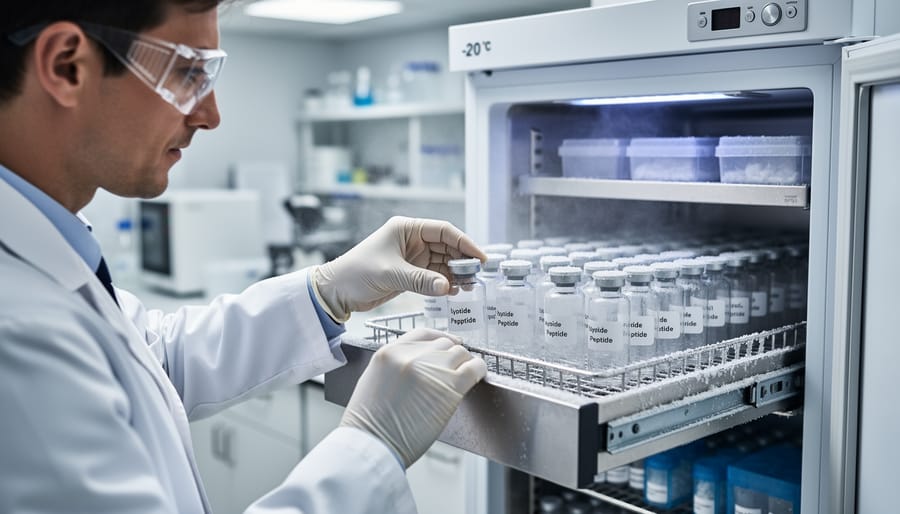
When a vial needs to sit for three months or longer, the freezer is where it belongs. A standard -20°C freezer is the usual choice for lyophilized peptides you won’t touch for a while, and at that temperature most stay stable for 12 to 24 months or longer. That’s a generous window, and it means you can order ahead without worrying about the clock.
Think of it like putting away winter running gear for the off-season. You tuck it somewhere reliable, and it’s ready when you need it.
Some researchers go further and use a -80°C unit for maximum stability. For most peptides, though, that’s optional rather than necessary, since a standard -20°C freezer is sufficient. Whichever you choose, check the supplier’s own storage guidance for your specific peptide.
Freezer vs. Fridge, Dimension by Dimension
Temperature Range and Storage Time
Think of “short-term” and “long-term” as a question about your calendar, not the vial. If you’ll use the peptide within one to three months, a standard refrigerator at 2-8°C does the job for lyophilized powder. If it will sit for three months or more, a standard freezer at -20°C is the better home.
Colder storage buys you time. At -20°C, most lyophilized peptides stay stable for 12-24 months or longer, which is a comfortable cushion for anything you won’t touch soon. Some researchers go to -80°C for maximum stability, but a standard freezer is enough for most peptides. Once a peptide is mixed, though, the fridge takes over.
Stability and Shelf Life
Colder storage buys time, and the numbers show it. In a standard refrigerator at 2-8°C, lyophilized peptides are meant for use within 1-3 months. Move them to a standard -20°C freezer, and most stay stable for 12-24 months or longer. That’s a big jump in shelf life from a simple change of temperature.
Why does it work? Cold slows the slow, quiet changes that wear on a peptide over time, so the powder holds up longer. Some researchers go to -80°C for maximum stability, but a standard -20°C freezer is sufficient for most peptides. Always check your supplier’s own storage guidance too.
Moisture, Light, and Freeze-Thaw Habits
Moisture, light, and constant temperature swings are the quiet enemies of a stored vial, so a few simple habits go a long way. In our experience, the easiest wins are keeping vials tightly sealed, storing them somewhere dry, and tucking them out of direct light. It’s a bit like the way you avoid mistakes before a run: small, consistent steps prevent bigger problems later.
Here’s a gentle routine for moving a vial between the freezer and the fridge:
1. Take the sealed vial out of the freezer and move it straight to the fridge.
2. Let it settle there before you open anything, and keep it capped the whole time.
3. Wipe away any condensation on the outside, not the inside.
4. Return it to cold storage promptly once you’re done.
Where you can, limit how often a vial goes back and forth, and always follow your supplier’s own storage guidance.
Lyophilized vs. Reconstituted: Why the Fridge Always Wins After Mixing
Once you mix a peptide, the rules change. Reconstituted peptides always need refrigeration at 36-46°F (2-8°C), so the fridge wins every time after mixing. The freezer question really applies to unmixed, lyophilized powder, the kind that ships as a freeze-dried form. Think of it as two stages: powder gets to choose between fridge and freezer based on how soon you’ll use it, while mixed peptides simply go in the fridge.
Pros and Cons of Each Storage Option
Neither option is “better” across the board. Each one simply fits a different stretch of time, and the small trade-offs are easy to manage once you know them.
Pros
- Refrigerator: it’s easy to reach, so grabbing a vial takes seconds.
- Refrigerator: the 2-8°C range suits lyophilized peptides you’ll use within 1-3 months.
- Refrigerator: it’s also where reconstituted peptides belong, so one cold space covers both needs.
- Freezer: -20°C supports storage of 3+ months.
- Freezer: most lyophilized peptides stay stable for 12-24 months or longer at that temperature.
Cons
- Refrigerator: the storage window is shorter, so it isn’t the best home for vials you’ll hold for many months.
- Refrigerator: you’ll want to watch your timeline so a vial doesn’t sit longer than planned.
- Freezer: it asks for a little planning, since you’ll want to think ahead before you need a vial.
- Freezer: moving vials between cold zones works best with a simple, consistent routine.
Think of it like pacing a training plan. The fridge is your everyday routine: quick, convenient, and perfect for what you’ll use soon. The freezer is the long-range plan, where a bit of forethought pays off in extra shelf life.
The “cons” here aren’t dealbreakers. A short note on the vial’s label with the date you stored it handles most of the fridge’s timing worry. For the freezer, the habit of moving a vial to the fridge ahead of time takes the sting out of the planning. Many researchers end up using both: the freezer for the long haul, the fridge for whatever’s in active use.
Setting Up Cold Storage at Home: Two Tools Worth Considering
Good storage doesn’t take fancy gear. It comes down to two things: a dependable cold space and a simple way to keep your vials organized. When both are in place, checking, labeling, and grabbing a vial becomes a quick habit instead of a scramble.
The two tools below are general-purpose household items, not peptide-specific equipment. We looked at them as everyday helpers, so confirm that any equipment fits your own space, your own needs, and your supplier’s storage guidance before you commit. A little planning now keeps the routine easy later.
Midea 3.1 Cu.ft Mini Fridge with Freezer: A Compact Two-Zone Option

A small fridge with a built-in freezer compartment puts both cold zones in one compact footprint, which is why the Midea 3.1 Cu.ft Mini Fridge with Freezer is a handy pick if your space is tight. The main compartment covers the 2-8°C range that suits lyophilized peptides you’ll use within 1-3 months, and it’s also where reconstituted peptides belong. The freezer compartment is there for longer-term storage, when you’re holding vials for 3+ months.
It’s Energy Star certified, it holds a 4.4 out of 5 rating from 6,022 customer ratings, and it’s listed as in stock. That kind of track record is reassuring for a small appliance you’ll leave running all day.
Here’s the candid part: a freezer compartment inside a mini fridge may not hold the same steady -20°C as a dedicated freezer. That’s the temperature you’re aiming for with long-term storage, so don’t just trust the dial. Put a small thermometer in the freezer section, check it over a few days, and adjust the setting until it reads where you want it.
Think of it as a practical two-zone setup for a dorm room, closet, or corner of a lab bench. Check the temperatures once, and you can store with confidence from then on.
Carlisle FoodService Products StorPlus Round Food Storage Container: An Organizing Helper

When you’re juggling several vials in a fridge or freezer, a loose pile gets frustrating fast. That’s where a simple container earns its spot. The Carlisle FoodService Products StorPlus Round Food Storage Container (2 Qt, translucent) is built for serving and storing hot or cold food, not for peptides, so think of it as an organizer rather than protection.
In our setup, the translucent walls were the biggest perk. You can see what’s inside without digging, which makes grab-and-go easy. Group your sealed vials together, add a label, and you’ve got one tidy bundle you can slide into either the fridge zone or the freezer zone.
It works well for keeping things findable, and it never replaces a vial’s own sealed packaging. Keep each vial in its original sealed form inside the container, and follow your supplier’s storage guidance.
Customers rate it 4.4 out of 5 from 313 customer ratings. Only 7 were left in stock at the time of our research, though stock may change, so check availability before you plan around it.
A small, clear container and a few labels can turn a cluttered shelf into a routine you’ll actually stick with.
Which Cold Storage Option Should You Choose?
Picking a spot for your vials is easier than it sounds. Start with how soon you’ll use the peptide, then match your situation to the setup that fits. Here’s a quick guide:
- If you’ll use a lyophilized vial within 1-3 months, a standard refrigerator at 2-8°C does the job.
- If you plan to store it for 3+ months, move it to a standard -20°C freezer, where most lyophilized peptides stay stable for 12-24 months or longer.
- If you’ve already mixed a peptide, keep it in the fridge at 36-46°F (2-8°C), every time.
- If you have a mix of unmixed and reconstituted vials, use both zones: powder in the freezer, mixed vials in the fridge.
- If space is tight, a compact fridge-and-freezer combo gives you both temperature zones in one small footprint.
Some researchers choose -80°C for maximum stability, and that’s a fine option if you already have access to one. But you don’t need it to do this well. A standard -20°C freezer is sufficient for most peptides, so there’s no reason to feel behind if that’s what you’ve got.
Think of it like organizing your running gear: the shoes you wear this week stay by the door, and the spare pairs go in the closet. Keep the vials you’ll use soon close at hand, and tuck the long-term stock away. Whichever setup you pick, follow your supplier’s storage instructions too. They know their product best.
Key Takeaways on Peptide Cold Storage
Here’s the short version, ready to bookmark. Lyophilized peptides you’ll use within 1-3 months do well in a standard refrigerator at 2-8°C. For storage beyond 3 months, a standard -20°C freezer is the better home, and most lyophilized peptides stay stable there for 12-24 months or longer.
A standard -20°C freezer is enough for most peptides. Some researchers choose -80°C for maximum stability, but you don’t need it to store your vials well.
Peptide Cold Storage FAQs

Can I keep lyophilized peptides in the fridge long term?
A standard refrigerator at 2-8°C is the right fit for lyophilized peptides you plan to use within 1-3 months. For anything beyond that, a -20°C freezer is the better home.
Is a regular freezer cold enough, or do I need -80°C?
A standard -20°C freezer is sufficient for most peptides, and most lyophilized peptides remain stable there for 12-24 months or longer. Some researchers choose -80°C for maximum stability, but it’s an extra, not a requirement.
Where do I store peptides after mixing?
Reconstituted peptides always go in the refrigerator at 36-46°F (2-8°C). The freezer question really applies to unmixed powder.
How should I handle vials when moving them between fridge and freezer?
Keep vials sealed and dry, away from light, and try to avoid repeated temperature swings. Plan your moves so each vial makes as few trips as possible, and label it so you always know where it belongs.
One last habit worth building: check the storage instructions that came with your peptides. Your supplier’s guidance for that specific product comes first, and the general rules above are a solid starting point when you’re setting up a routine.
The rule of thumb is simple enough to remember on a tired Tuesday night: fridge for the short haul, freezer for the long haul, and fridge again once a peptide is mixed. Lyophilized vials you’ll use within a few months can sit comfortably at 2-8°C. Anything you’re holding for 3+ months belongs in a -20°C freezer, and reconstituted peptides always go back to 2-8°C.
Think of it the way you think about recovery. Nobody notices a good stretching routine on race day, but it quietly protects every mile you’ve put in, and it helps you stay injury-free for the long run. Storage works the same way. A few steady habits protect all the care that went into getting your materials in the first place.
So don’t leave it for later. Pick your cold spot, check it with a thermometer, put your vials in a tidy container, and label everything with the date. Ten minutes today sets you up for a routine you’ll barely have to think about. You’ve got this.