
Yes, you can run a half marathon without formal training, and thousands of people do it every year. But here’s what that really means: you’re trading structured preparation for a much higher risk of injury, a tougher experience on race day, and potentially weeks of painful recovery afterward. The truth lies somewhere between the inspirational stories and the stark warnings from sports medicine professionals.
The search query itself tells a story. Maybe you signed up on impulse, supporting a friend or charity. Perhaps race day crept up faster than expected, life got in the way of your training plan, or you’re simply curious whether your current fitness level can carry you through. Whatever brought you here, you need honest guidance, not cheerleading or scare tactics.
I’ve spoken with runners who crossed the finish line on determination alone, and I’ve watched others limp off the course at mile eight with injuries that sidelined them for months. The difference wasn’t luck. It came down to understanding what their bodies could handle, respecting critical safety boundaries, and making smart decisions before, during, and after the race.
This guide won’t pretend that skipping training is ideal. It is, however, designed for the reality you’re facing right now. You’ll learn the minimum fitness baseline required, how to protect yourself from the most common injuries, what to do in the crucial 72 hours before race day (including the research-backed recommendation to rest at least three days before the event), and how to pace yourself when you have no training data to reference.
What You Absolutely Need Before Attempting This
Your Current Fitness Baseline
Let’s be blunt: if walking up two flights of stairs leaves you winded, a half marathon without training isn’t brave, it’s reckless. The minimum baseline means you can jog continuously for at least 20-30 minutes, even at a slow pace, without needing to stop. You should be walking several miles regularly or doing some form of cardio multiple times per week. This isn’t elite fitness, but it’s the foundation that separates a difficult challenge from a medical emergency.
Sarah, a recreational cyclist, signed up for a half marathon two weeks out with zero running background. She could bike 20 miles comfortably, but running uses different muscles and pounds your joints differently. She finished, but spent the last four miles shuffling at a near-walk because her quads cramped from the repetitive impact her cycling fitness hadn’t prepared her for. Compare that to Mike, who walked his dog three miles daily and occasionally jogged short segments. He run-walked the entire distance and recovered within a week.
The research on training patterns linked to injury confirms what common sense tells us: your body needs gradual adaptation to handle distance running. If your current activity involves zero weight-bearing exercise, you’re setting yourself up for stress fractures, severe blisters, or worse.
Essential Gear and Supplies
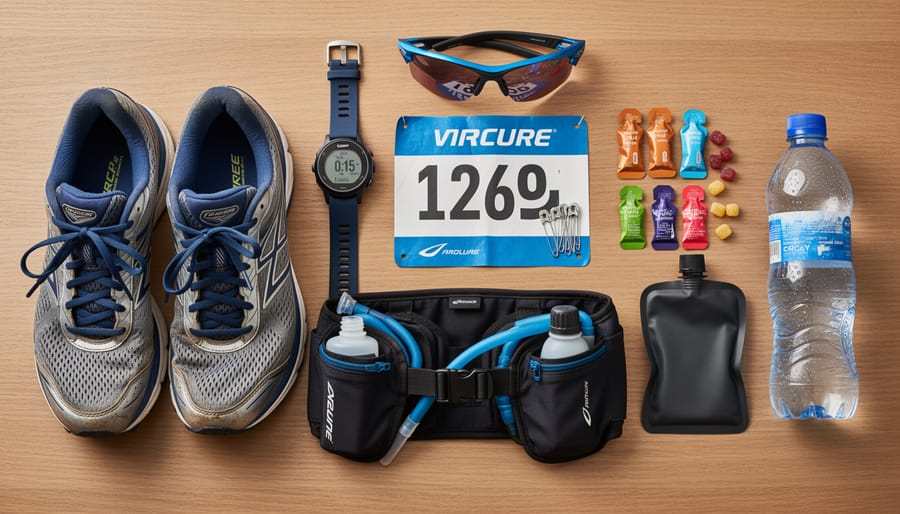
Your shoes matter most, and they need to be broken in already. Don’t show up in brand-new running shoes, blisters and hot spots will end your race before mile five. Wear the shoes you’ve been walking or doing light runs in for at least two weeks. They should feel comfortable right now, not after “breaking them in during the race.”
Moisture-wicking clothing is non-negotiable for 13.1 miles. Cotton absorbs sweat and creates friction points that will chafe badly over two-plus hours of movement. Get synthetic or merino wool fabric for your shirt, shorts, and especially socks. Apply anti-chafe balm or petroleum jelly anywhere fabric rubs, inner thighs, underarms, nipples. This sounds dramatic until you experience the reality at mile ten.
Your hydration strategy needs to be simple since you haven’t practiced it. Carry a handheld water bottle or plan to stop at every aid station on the course. Dehydration will wreck you faster than lack of training. For energy, grab something easily digestible, a few energy gels, chews, or even gummy bears in your pocket. Take one every 40-45 minutes whether you feel hungry or not.
Finally, consider blister prevention seriously. If your feet are prone to blisters, tape hot-spot areas before the race or wear double-layer socks. One blister can turn the second half into genuine misery, forcing you to alter your gait and creating new problems elsewhere.
Critical Safety Warnings and When to Stop

The 3-Day Pre-Race Rest Rule
If you’ve found yourself signed up for a half marathon with days to spare, your instinct might be to squeeze in a few desperate runs. Don’t. The verified guideline is simple: leave at least three full days of no training before the event. Those last-minute miles won’t build fitness, you can’t manufacture endurance in 72 hours, but they will drain the limited energy reserves your body needs for race day.
Cramming makes things worse because you’re stacking fatigue on top of your already undertrained state. Your muscles need glycogen stores fully topped up, not depleted from panic workouts. Any gains from a Thursday run before a Sunday race are purely psychological, while the physical cost is real.
Instead, use those final days to avoid common pre-run mistakes: focus on hydration, eating normally (don’t carb-load like trained runners), getting extra sleep, and laying out your race gear. Walk gently if you’re anxious, but resist the urge to test your readiness. Save every bit of energy for the 13.1 miles ahead.
During-Race Warning Signs
Your body will tell you the difference between pushing hard and pushing into injury territory, but you need to know what signals demand immediate action. Sharp, localized pain, especially in your shins, knees, or feet, means stop running immediately and walk or drop out. This isn’t the dull ache of tired muscles; it’s stabbing, specific pain that worsens with each step. That sharp sensation could indicate serious issues including stress fracture risk and continuing will turn a manageable problem into months of recovery.
Chest pain, dizziness, or feeling like you can’t catch your breath even after slowing down requires stopping completely. Find a medical volunteer or race official right away. The same goes for severe cramping that doesn’t ease when you walk, sudden vision changes, or confusion, these aren’t normal race discomfort.
Here’s the distinction that matters: burning lungs, heavy legs, and general fatigue are expected when you’re undertrained. You can walk through those. But pain that makes you limp, changes your gait, or feels worse than anything you’ve experienced before means your race is over. There’s no shame in the medical tent or catching the sweep bus. Finishing this race isn’t worth an injury that prevents you from running next year.
How to Actually Do It: Race Day Strategy
Start Slower Than You Think
The first mile will feel deceptively easy, and that’s exactly the problem. Adrenaline from the crowd, nervous energy, and watching faster runners stream past creates an almost irresistible urge to match their pace. Most untrained runners go out at least 30 seconds per mile faster than they can sustain, then hit a wall around mile 4 when their body realizes what just happened.
Your goal is simple: start so slow it feels almost embarrassing. If you can normally run a 5K without stopping, add two full minutes to whatever pace that would be. If you’ve never run consistently, your starting pace should allow you to hold a conversation without gasping. A pace chart can provide structure, but without training data to reference, you’re better off using the talk test, if you can’t speak in complete sentences, you’re going too fast.
Fight every instinct to speed up in the first three miles. The runners passing you now will be walking later, and you’ll run past them at mile 8 if you’ve conserved your limited energy reserves from the start.
The Run-Walk Method for Survival
Start using run-walk intervals from mile one, not when your legs give out at mile eight. The most sustainable ratio for untrained runners is one minute of running followed by one minute of walking, repeated throughout the entire race. This isn’t a backup plan, it’s your primary strategy.
Set a timer on your watch and stick to the intervals rigidly, even when you feel good in the early miles. That fresh feeling won’t last, and if you’ve already burned through your limited reserves by running the first five miles straight, you’ll be reduced to a painful shuffle later. The walk breaks serve a specific purpose: they lower your heart rate, give your muscles brief recovery, and prevent the complete muscular failure that happens when untrained runners push to exhaustion before walking.
Some runners prefer a 2:1 ratio (two minutes running, one minute walking) if they have any running background at all, while others need to flip it to 1:2 when fatigue sets in after mile ten. The key is starting the intervals immediately and treating the walk portions as scheduled recovery, not admissions of defeat. You’ll pass people who sprinted the first half and are now limping. Walk with purpose during your breaks, maintain a brisk pace rather than stopping completely, and you’ll cover the distance without destroying your body in the process.
Fueling Without a Tested Plan
Your stomach hasn’t rehearsed digesting fuel while bouncing for an hour, which means race day isn’t the time to experiment with whatever looks interesting at the aid stations. Stick with water for the first 45 minutes unless you’re already feeling depleted. Your body has enough stored energy to get you through that initial stretch without adding digestive complications.
At the first water station around mile 3 or 4, drink a few sips, not a full cup. Dumping cold liquid into an unprepared stomach while running often triggers cramps or nausea. Take small amounts frequently rather than waiting until you’re desperately thirsty.
Around mile 6 or 7, you’ll need simple carbohydrates. If the aid station offers sports drinks, take half a cup and alternate it with water at the next stop. The sugar hits your bloodstream faster than gels, and the dilution helps prevent the sloshing-stomach feeling. Skip energy gels entirely unless you’ve tried that exact brand before. Many untrained runners experience immediate stomach distress from the concentrated texture and sweetness.
If you feel nauseated, slow to a walk and sip water only until it passes. Don’t force nutrition when your gut is rebelling. From mile 10 onward, prioritize hydration over food, you’re close enough that your remaining glycogen can carry you through if necessary. The goal is reaching the finish line functional, not perfectly fueled.
What to Expect: Time, Pain, and Reality
How Long It Will Take You
If you’re attempting a half marathon without training, expect to finish somewhere between 2.5 to 4 hours depending on your baseline fitness and how much you walk. Someone who runs occasionally or does other cardio might manage a 2:45 to 3:15 finish with strategic run-walk intervals, while a completely sedentary person walking most of the course could take 3:30 to 4 hours or more. The difference between continuous walking and run-walking can be 30 to 45 minutes, but that gap narrows if you’re not fit enough to sustain the running intervals.
Here’s what matters more than your time: whether you cross the finish line without injury. A slower pace with regular walk breaks puts far less strain on untrained muscles and joints than pushing to maintain a faster time. Your body hasn’t built the protective conditioning that comes from weeks of progressive training, so every minute you spend running instead of walking increases injury risk.
Forget about matching trained runners or hitting some arbitrary goal. If you finish upright and can still incorporate mobility workouts into your recovery the next week, you’ve succeeded.
The Next 48 Hours
You’ll feel it before you even get out of bed the next morning. Your legs will be stiff, possibly locked up, and those first steps to the bathroom might require holding onto furniture. This is normal when you’ve asked your body to do something it wasn’t prepared for. The difference between you and trained runners isn’t just the intensity of soreness, it’s that your muscles have zero adaptation to this specific stress, so the damage is deeper and recovery takes longer.
Expect significant difficulty with stairs, sitting down, and standing up for at least two days. Your quadriceps will likely hurt the most, especially when lowering yourself into a chair or walking downhill. Many untrained finishers report that day two feels worse than day one as delayed onset muscle soreness peaks.
Your immediate priorities are simple: gentle movement, not rest. Walking, even slowly, keeps blood flowing to damaged muscles. Stay hydrated and eat protein-rich foods to support repair. Ice any specific pain points, but don’t ice everything, some inflammation is part of the healing process.
Watch for swelling that doesn’t decrease, sharp pains that worsen rather than improve, or inability to bear weight on one leg. These aren’t normal soreness and need medical attention. Most discomfort should start easing by day three, though you might feel residual tightness for a week.

After You Finish: Recovery and What’s Next
Monitoring for Delayed Injuries
Normal muscle soreness peaks 24 to 48 hours after your race and feels symmetrical, both legs equally tight, stiff when you stand up, tender when you press the muscles. This is expected. What’s not normal: sharp pain in one specific spot, swelling that doesn’t reduce with elevation and ice, pain that gets worse instead of better after day three, or inability to bear weight on one leg.
Common injuries from untrained half marathon attempts include IT band syndrome (pain on the outer knee), plantar fasciitis (stabbing heel or arch pain, especially with your first morning steps), stress fractures (pinpoint bone pain that hurts more with activity), and Achilles tendinitis (pain and stiffness in the back of your ankle). If you’re limping, can’t climb stairs normally by day four, experience numbness or tingling, or notice joint swelling that persists beyond 72 hours, see a doctor or physical therapist.
Trust your instinct. If something feels distinctly different from general muscle fatigue, a pain that makes you wince or changes how you move, get it checked rather than hoping it resolves on its own.
If You Want to Do This Right Next Time
If you survived your untrained half marathon and want to avoid that survival-mode experience next time, proper training changes everything. Building a base before race day means you can actually enjoy the run instead of enduring it.
A solid training plan typically spans 10-14 weeks and gradually increases your weekly mileage so your body adapts without breaking down. You’ll do three to four runs per week, mixing easy miles with a weekly long run that slowly builds toward race distance. This approach gives you the kind of base you need to run a half marathon comfortably without getting hurt.
The difference is stark. Trained runners finish feeling accomplished rather than destroyed. They can walk normally the next day. They smile in race photos instead of grimacing. They cross the finish line thinking “I want to do that again” rather than “never again.”
Training also lets you set meaningful time goals and actually race the distance instead of just completing it. You learn what fueling strategy works for your body, what pace you can sustain, and how to handle the mental challenges that come up around mile 10. The race becomes a celebration of your preparation rather than a test of your pain tolerance.
Frequently Asked Questions
Can I just walk the entire half marathon?
Yes, you absolutely can walk the full distance, and many people do. Walking significantly reduces injury risk compared to running without preparation, though you’ll need to check the event’s time cutoff to ensure you can finish within the allowed window.
Will running a half marathon without training permanently damage my body?
A single untrained attempt won’t cause permanent damage for most people, but it dramatically increases your immediate injury risk. The key is stopping if you experience pain beyond normal muscle fatigue and allowing proper recovery afterward rather than jumping into another race.
What happens if I need to drop out during the race?
Dropping out is always an option and is the smart choice if you’re experiencing warning signs like sharp pain, dizziness, or extreme breathing difficulty. Race organizers have support vehicles and volunteers along the course specifically to help runners who can’t continue.
Will I be the last person to finish?
Probably not. Half marathons attract participants of all speeds and abilities, including walkers and first-timers. Finish times vary widely, and there will almost certainly be others moving at your pace or slower throughout the race.
These questions get at the core anxiety of attempting something outside your preparation level. The honest answer is that walking, slowing down, or stopping doesn’t make you a failure. It makes you someone who listened to their body and made a smart decision in the moment. The runners who regret their untrained half marathon attempts are typically the ones who ignored pain signals and pushed through warning signs, not the ones who adjusted their approach mid-race.
Remember that trained runners have spent weeks or months building the conditioning base you’re attempting to skip. Their experience will be fundamentally different from yours, and that’s okay. Your goal isn’t to match their pace or strategy but to get through the distance as safely as possible given your starting point.