
A 30-minute treadmill session burns roughly 200 to 400 calories for most people, and you can work out a closer number for yourself in about five minutes with nothing more than your body weight, your workout time, and a simple formula. The range is wide because calorie burn depends on how hard you’re moving and how much you weigh, not just how long you’re on the belt.
That’s good news. It means your result isn’t a mystery, and it isn’t fixed. A 150-pound walker at an easy pace and a 190-pound runner at a steady jog will land in very different places, and both numbers are worth knowing.
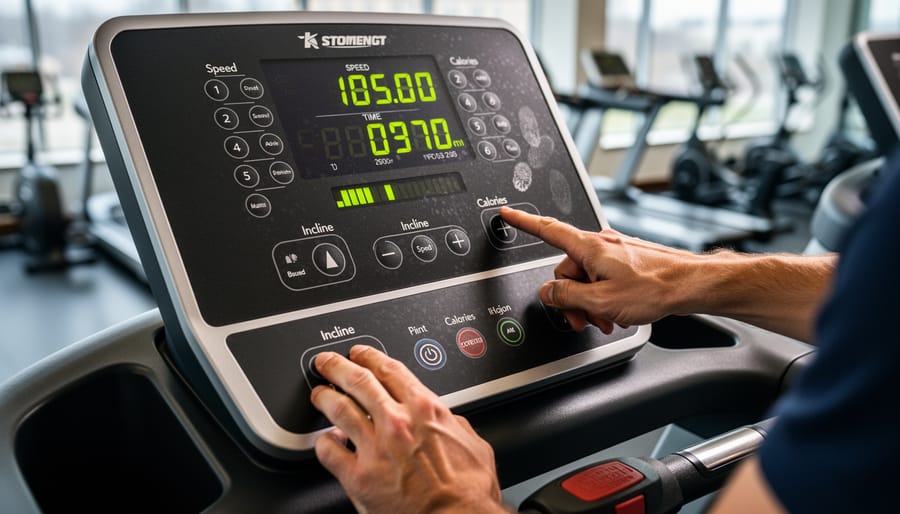
Think of the treadmill display as a helpful guess rather than a verdict. Many runners start out trusting that little calorie counter, then wonder why it doesn’t match their watch or their friend’s workout. The reason is simple: those readouts rarely know your weight or effort the way you do.
This guide shows you how to estimate your burn step by step, with a worked example. We’ll also compare common treadmill workouts, share safe ways to burn a little more, and explain how to check your results so you can trust the number you land on.
What Decides How Many Calories You Burn on a Treadmill
Your treadmill calorie burn comes down to a handful of things you can see and control, plus one that’s personal to you.
Body weight matters because moving a heavier body takes more energy. Two people on the same treadmill at the same pace will land on different numbers, and that’s completely normal.
Speed is next. Jogging at a steady clip burns more per minute than a casual stroll, simply because your muscles are working harder to carry you forward.
Incline is the sneaky booster. Even a gentle slope asks your legs and glutes to do more, so a brisk uphill walk can rival an easy jog without the extra impact on your joints.
Duration is the simplest piece: more minutes on the belt means more total calories, as long as you keep a steady effort.
Finally, there’s how hard it feels. Your effort level, from comfortably chatty to breathing hard, reflects how much work your body is really doing.
To put all of this in one rating, exercise scientists use something called METs, or metabolic equivalents. Think of a MET as a score for how demanding an activity is compared with sitting still. Resting is 1 MET, an easy walk is a few METs, and a steady jog is higher. Higher number, harder work, more calories burned.
Here’s the encouraging part: every runner’s number is a little different, and that’s okay. Age, fitness level, and even the day you’re having all play a role. So treat any estimate as a helpful starting point, not a score to beat. What counts is that you’re showing up and building a habit you enjoy.
What You’ll Need to Track Your Treadmill Calorie Burn (Tools and Materials)

You don’t need a fancy setup to get a solid estimate of your treadmill calorie burn. Most of what you need is probably already within arm’s reach. Here’s a simple checklist to gather before you start:
- A treadmill with speed and incline readouts, so you know exactly what pace and slope you’re working at.
- Your current body weight, since it’s the biggest input in the calorie formula.
- A timer, or the treadmill’s built-in clock, to track how long you actually move.
- An optional heart rate monitor or GPS watch if you’d like a second opinion on effort.
- A calculator or MET-based calorie chart to turn your numbers into an estimate.
- A notebook or app for logging each workout so you can spot trends over time.
A quick word about the gadgets: the calorie counter on your treadmill and the one on your watch are both estimates, and they won’t always agree with each other. That’s completely normal. Machines often don’t know your weight, age, or fitness level, and wearables make their own educated guesses from heart rate and movement. Neither one is “wrong,” they’re just working with different information.
Think of these tools as a friendly starting point rather than a scoreboard. Pick one method, use it consistently, and you’ll get a reliable picture of your own progress. If you want a little extra confidence, hop on the treadmill and check how your numbers compare. A few minutes of tracking is enough to get you started.
Safety First: Warnings and When to Slow Down or Stop
Burning more calories only counts if you get through the workout feeling good, so let’s set a safe foundation first. Start every session with a few minutes of easy walking to warm up your legs, lungs, and heart. If you’re brand new to training, our exercise tips for beginners are a friendly place to begin.
Clip the safety key to your clothing before the belt starts moving. It stops the machine instantly if you stumble, and it takes two seconds.
Resist the urge to grip the handrails. Leaning on them lowers the work your body does, so any calorie estimate you calculate will come out too high. Let your arms swing naturally instead. Likewise, don’t crank the speed or incline past what feels comfortable just to chase a bigger number. A steady, sustainable effort beats a heroic one you can’t repeat next week. Keep water nearby and sip as needed.
If you have heart, joint, or other medical concerns, or you’re new to exercise, check in with your doctor before building a routine. Know your stop signals too: dizziness, chest pain, unusual shortness of breath, or sharp joint pain all mean it’s time to slow down or step off. If a nagging ache sticks around, read up on foot pain in runners and rest before you push on.
You’ve got this, and listening to your body is part of getting stronger.
Step-by-Step: Estimate Your Calories Burned on the Treadmill
Ready to find your own number? Here’s the full process, start to finish. It takes about five minutes once you’ve done it a couple of times.
- Warm up for five minutes at an easy walking pace so your body is ready to work.
- Pick your treadmill exercise, such as brisk walking, jogging, or incline walking, and set your speed and incline. Keep them steady so your math stays simple.
- Note your duration using the treadmill clock or a timer, and write down how many minutes you spent at that effort.
- Find the matching MET value from a basic chart. Walking at a moderate pace is roughly 3.5 METs, and jogging at about 5 miles per hour is roughly 8 to 9 METs.
- Convert your weight to kilograms by dividing your weight in pounds by 2.2.
- Apply the formula: MET x weight in kg x time in hours = calories burned.
- Cross-check your result against your treadmill display or watch. Expect small differences.
- Log it in a notebook or app so you can spot trends over time.
Let’s walk through one example. Say Maya weighs 150 pounds and jogs for 30 minutes at about 5 miles per hour. Her weight in kilograms is 150 divided by 2.2, which is about 68 kg. Jogging at that pace is roughly 8.3 METs, and 30 minutes is half an hour, or 0.5 hours.
Now multiply: 8.3 x 68 x 0.5 comes to about 282 calories. That’s it. No fancy gear, no advanced math, just three numbers and a calculator.
Notice what happened there. The only inputs were an activity rating, a body weight, and a time. If Maya adds a little incline or picks up the pace, she just swaps in a higher MET value and runs the same steps again.
A quick tip if the numbers feel fiddly: write the formula on a sticky note and keep it near the treadmill. After a few workouts, you’ll be doing it in your head. And remember, this is an estimate, not a score. It’s a friendly guide that helps you see your progress, and every workout you log is a win.
Calorie-Burning Treadmill Exercises Compared: Walking, Jogging, Incline, and Intervals

Treadmill workouts all burn calories, but they feel very different and suit different runners. The ranges below are for a sample 155-pound (70 kg) person. Your number will land higher or lower depending on your weight, effort, and fitness, so treat them as a starting point.
Brisk walking (3.5 to 4 mph, flat)
Roughly 250 to 300 calories in 45 minutes. This is the friendliest place to begin, easy on the joints and simple to sustain. It’s ideal for beginners, anyone returning after a break, and runners wanting an easy recovery day.
Steady jogging (5 to 6 mph, flat)
Roughly 350 to 450 calories in 40 minutes. Jogging raises your heart rate and your burn without much planning. It suits beginners who’ve built a walking base and experienced runners who like a rhythm they can settle into.
Incline walking (including 12-3-30 style routines)
A 12-3-30 workout means a 12% incline, 3 mph speed, and 30 minutes of walking. Many people burn around 250 to 350 calories this way. The hill makes your legs and lungs work harder while the pace stays gentle, so it’s great for beginners who want more challenge without running, and for experienced runners who want a low-impact day. Because climbing asks a lot of your calves, hips, and ankles, a little prep goes a long way, and adding some mobility workouts to your week can help you stay comfortable and consistent.
Interval runs
Roughly 300 to 450 calories in 30 minutes, depending on how hard your hard efforts are. A simple pattern is one minute at a comfortably hard pace followed by two minutes of easy jogging or walking, repeated. Intervals suit intermediate and experienced runners, though beginners can try gentle versions with walking breaks. They also keep time moving quickly, which many people love.
A quick snapshot of how they stack up:
– Walking: lowest impact, easiest to repeat daily
– Jogging: a solid all-rounder
– Incline walking: more effort without more impact
– Intervals: the most calories per minute, with more demand on your body
One runner I know, Dana, spent months on the same 30-minute jog and found herself dreading the treadmill. She started alternating weeks: incline walks one day, short intervals the next. “It felt like I had a little menu to pick from,” she told me. Within a month she was actually looking forward to her sessions, and showing up consistently mattered far more than any single workout.
Remember that every number here is an estimate. The best treadmill exercise is the one you’ll enjoy doing again tomorrow.
Tips to Burn More Calories Without Burning Out
Small tweaks add up faster than heroic efforts. Start with a gentle incline. Raising the belt to 1 or 2 percent, then working up to 3 to 5 as it feels comfortable, makes the same pace burn more without asking you to run faster. Try a few short intervals next. Alternate one minute of brisk effort with two minutes of easy recovery, and repeat a handful of times. It’s a friendly way to add intensity without feeling wiped out.
Extend your sessions gradually, too. Adding five minutes every week or two gives your joints and your motivation time to catch up. Let your arms swing naturally at your sides rather than clinging to the handrails, since that keeps your form honest and your numbers truthful.
Consistency beats intensity every time. Three moderate workouts a week that you actually enjoy will do more than one punishing session you dread. One of my running friends stopped chasing hard days and simply showed up more often. Within a couple of months, her treadmill workouts felt easier and her energy had climbed.
Food matters here, too. If you want to lose fat as a runner pair your workouts with balanced meals rather than crash dieting. Fuel up with some carbs and protein, drink water, and give yourself credit for the habits you’re building. Sustainable routines carry you much further than extreme efforts ever will.
Checking Your Numbers and Planning Your Next Workout (Verification and Next Steps)
Once you have your estimate, compare it with what your treadmill and watch show. Don’t be surprised if all three numbers differ a little. Each one uses slightly different assumptions about your weight, pace, and effort, so a gap of 10 to 20 percent is normal. Pick one method, stick with it, and use it consistently.
The real value comes from trends. Log your workouts for three or four weeks and watch how your numbers move. If the same speed and incline start to feel easy, that’s your cue to nudge things up: add a minute of jogging, raise the incline by half a percent, or extend your session by five minutes.
Then set one simple next goal, like completing three tracked workouts a week or adding a short interval block.
If you’re a beginner, focus on showing up and building the habit before chasing bigger numbers. If you’re more experienced, try pairing your treadmill sessions with a weight training plan to build strength and support your pace.
When you’re ready, explore our guides on running shoes, GPS watches, and healthy eating to round out your routine.
Treadmill Calorie Burn: Your Questions Answered
Most of these questions come up for runners at every level, so here are friendly, straight answers.
Is the treadmill’s calorie counter accurate?
It’s a helpful estimate, not an exact reading. Many machines use general formulas that don’t know your exact weight or fitness level, so treat the number as a rough guide and compare it with your own MET-based calculation.
Do I burn more running or walking on an incline?
Running at a steady pace usually burns more per minute than walking, but a steep incline walk can come surprisingly close. Pick whichever you can keep up comfortably, since the workout you’ll actually repeat is the one that counts.
How many calories do I burn in 30 minutes?
It depends on your weight, speed, and incline, so there’s no single answer. Plug your own numbers into the MET formula from the step-by-step section and you’ll have a personal estimate in a minute or two.
Does holding the handrails change the number?
Yes, it can. Leaning on the rails takes some of the work off your body, so you likely burn fewer calories than the display suggests. Letting your arms swing naturally keeps your form better and your estimate more honest.
As for weight loss, burning calories on the treadmill is one helpful piece of the puzzle, but it rarely works on its own. Everyday eating habits, sleep, and consistency all play a part too. If you have specific health goals or medical concerns, a quick chat with your doctor or a registered dietitian can help you build a plan that feels good and lasts.
You don’t need a lab or a complicated formula to understand your treadmill workouts. Your weight, your speed, your incline, and your time are enough to get a solid estimate, and that number is simply a helpful guide, not a verdict on how well you did. Some days the figure will look big, other days small, and both kinds of days count.
What matters most is showing up and enjoying the process. Consistency beats intensity every time. So lace up, pick a speed that feels good, and track your first workout today. Your future self will thank you.